
Photo:
BY Graham Zimmerman
BY Graham Zimmerman
Before Sloane arrived, my life as a climber was defined by scale. Long expeditions, sprawling training blocks, and huge windows of time in far-off ranges. I would regularly put in 20 to 30 hours of training a week, sharpening myself for months in the Karakoram, Alaska, or South America, chasing cutting-edge lines that required total commitment.
Now, the numbers tell a different story. Fifteen hours a week of training feels like a win. Time in the hills is measured in days, not months. And while I still crave the high, cold air of the alpine, I am unwilling to trade too many nights away from home for it.
This is not a loss. It is a shift. One that has surprised me with how natural it feels. Every extra bedtime I am home for, every early-morning giggle I get to hear, these moments are as precious as any summit photo. The tighter constraints have become a kind of forcing function. If I am going to keep climbing at a high level, I have to train smarter, move more efficiently, and make every mountain day count.
Nearly a year into fatherhood, here is what that evolution looks like. Imperfect, evolving, but deeply rewarding.
Redefining Training: Efficiency Over Volume
A more flexible schedule
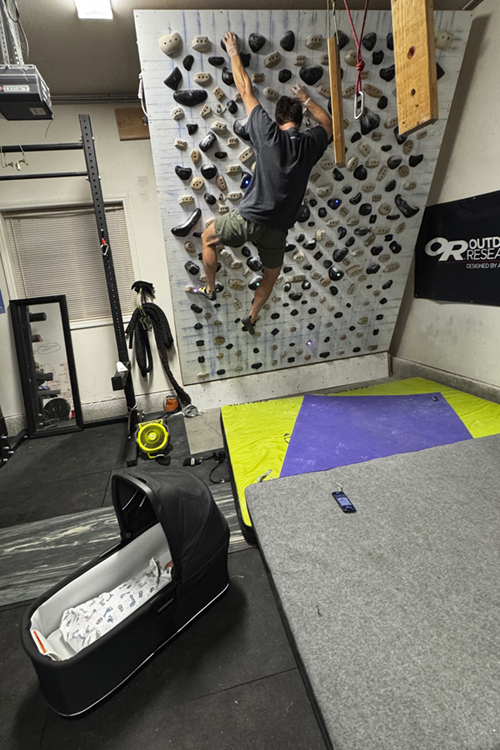
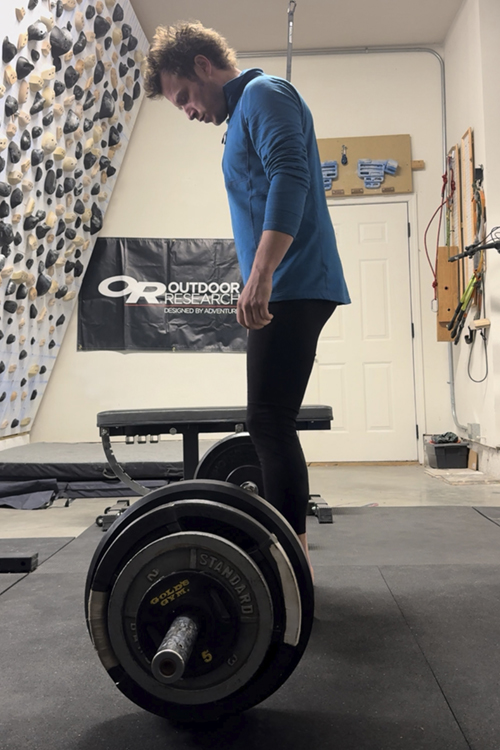
I still aim for 15 to 20 hours of training a week, but the structure is more fluid. Long, uninterrupted blocks are rare. Now, training often happens in fragments: twenty minutes for a core circuit, forty-five for a garage board session, an hour for hangboarding stacked with lifting.
Warm-ups, once leisurely, have become exercises in multitasking. Sometimes it is calisthenics while Sloane plays on the floor, other times it is cycling through a Tindek set while answering emails. The goal is not perfection, it is persistence and creativity.
Baby-inclusive training
Some sessions now include a very small, very cute training partner. For Zone 2 cardio, I will ruck with Sloane strapped to my chest. On good-weather days, I pull her in the chariot on skis or the bike. Occasionally she even becomes part of my core routine, which is hilarious, great for balance, and heart-melting in a way no kettlebell ever could be.
Of course, not every experiment works. I once tried to use her as extra weight for lower-body muscular endurance workouts, carefully removing all the jumping components. She loved it, giggled, napped, and drooled on my shirt. Unfortunately, after one particularly sweaty session, she developed a rash, and my baby-as-weight-vest program was promptly retired.
Training structure in practice
A typical week now looks something like this:
The days are not as long and the sessions are not as monolithic, but the consistency is there. And that is what matters.
Note: I am tracking and sharing this training on Strava, check in out here [link: https://www.strava.com/pros/12252381]
Embracing the Chaos
Nothing goes as planned, and that is OK
With a baby in the house, workouts get interrupted, illness makes surprise appearances, and carefully plotted training blocks fall apart without warning. I have had to let go of the idea that success is about executing the perfect plan. Now, flexibility is part of the training. It is like adapting to a storm system in the mountains or pivoting mid-route when conditions change.
Mental adaptation
On nights when bedtime stretches on and I do not start training until 10 p.m., the goal shifts from peak performance to mental and physical wellness. Box breathing helps me refocus. Free diving breathing techniques train my lungs and heart while giving me a sense of calm in the chaos.
The unpredictable nature of parenting feels familiar. Big alpine objectives taught me to be patient, adaptable, and persistent. Those same skills apply here, and in return, fatherhood sharpens my ability to embrace uncertainty in the mountains.
Going to the Mountains with New Intention
A shift in how I go and why
Some parents step back from climbing entirely during this stage of life, which is a valid choice. For me, it has been the opposite. I know I will keep going to the mountains, but my style is evolving.
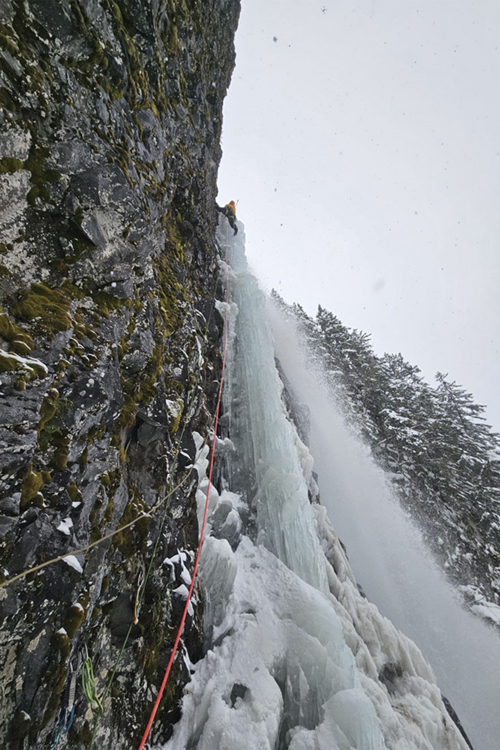
Instead of months in remote ranges, I find myself exploring closer to home. In Oregon, that has meant one-day pushes to new spray waterfall routes at Willamette Pass or steep faces on the volcanoes. These days are about seeing what I can get done from my front door.
I also make quick-hit missions to Washington or Canada, flying in, climbing hard for two or three days, and flying home. No rest days on the road. Those are for home.
Safety and decision-making
While I have always worked hard to keep things safe, I now lean toward routes where I can place more rather than less gear. Climbing on thin margins is less appealing than it used to be.
Letting go of the extra push
I used to always try to add one more thing, whether that was an extra lap on a climb, one more errand, or another set in training. Now, when I feel that temptation, I often pull back. Getting home on time and being fully present as a father and partner matters more.
Advocacy with a New Lens
A deeper stake in the future
I have been involved in climate and public lands advocacy for years, but becoming a father raised the stakes in a way I could not have imagined. My investment in the future is no longer abstract.
I often talk about Sloane when I meet with decision-makers, from senators to community members. Framing these issues in terms of her future resonates and opens conversations that might not otherwise happen.
Note: If you love the outdoors, speak up for them. Check out my Substack for inspiration and practical steps you can take to protect the places that matter [LINK: https://substack.com/@grahamgzimmerman].
The Mountain and the Home
Life is different now. Harder in some ways, more beautiful in others. I am not less of a climber. I am simply a different kind of climber.
Plato wrote, The best way of training the young is to train yourself at the same time; not to admonish them, but to be seen never doing that of which you would admonish them.
I want Sloane to grow up knowing that she can do anything she puts her mind to. I am working to show her that in real time, even now, when she is tiny.
The alchemy is in holding on to what matters while evolving with love, responsibility, and purpose.